Three days of Tokyo. You would think it would be amusing but under the fear and unspoken threat of immediate job lossage if you don’t attend the seminars, I know I was not the only one who did not wander about the town as much as I would have liked. (It may also have a lot to do with the fact that I was adjusting to the time difference upon arrival.) These first few days are considered a part of your job, so it is probably best if you can try to treat it as such. Besides, you’ll have plenty of opportunity to plan your own leisure Tokyo trip when you want later. I plan to go back ASAP!
For my free time, I went for tsukemen the first night and hit an izakaya for drinking with a few other newcomers who were from my home state who I wouldn’t see for a while after orientation. There is no shortage of these types of places in the area so I suggest just hitting the pavement and experiencing the city as much as you can. The next night I met up with a Japanese friend I have in the Shinjuku area. She took me to a government building nearby that gives a really good view of surrounding Tokyo scenery and landscape. It was pretty impressive. Then we ate and had a general good time catching up. We wandered around a mall a bit, then I insisted on purikura and hitting a bookstore and we wrapped it up because I had an early morning in store.
When you get to the hotel -hopefully it will still be Keio Plaza Hotel, which is super nice and sparkles- you’ll likely have completely accessible wi-fi, so wait to break out your computers then; don’t run up a foreign cell phone bill unnecessarily. Figuring out ATMs was interesting as well. Just an FYI, you can definitely get money out of a 711 ATM. I was denied at a Japan Post (JP) ATM, which may have been because I use a regional bank but it could also just be their general practice. Another thing is, that for those who brought money in cash and wish to exchange, you can hit the Money Exchange Desk, right next to reception in Keio Plaza. Just a few cool tips.
For those of you accepted and coming in this year though, it may be a little less of a reception than you had hoped. If the Consulates are still telling you that you will have a large welcome committee at the airport, this may no longer be true; CLAIR has eliminated the (unto now) yearly tradition of finding and bringing in Tokyo Orientation Assistants (TOAs). This will unfortunately mean an increase in, for lack of a more polite way to say it, boring and less practical advice presentations when you arrive. Unless they illuminate us on the details of who will be giving the presentations later, it may just be straight CLAIR presentations for two and a half days. Now I enjoy a good talk about rules and how systems work and maybe an outstanding keynote speech now and then, but after a long plane ride it is wearisome and many of you will likely fall asleep in your chairs because you literally sit and listen to someone speak the whole time. If that is the case, don’t feel bad, you are not the only one.
On a broader note, CLAIR has made a lot of changes lately that lead me to believe changes are coming for the program in general (for better or worse) but who knows? It seems that major changes are only implemented every ten years to the education curriculum and such, no matter when originally assessed and approved, but this could also vary by region. Just consider these the random ramblings of a second year.
For those of you coming in, you most likely won’t miss the old things because you didn’t know that they were in place, but some of us are a bit sad to see them go. I know I was looking forward to applying to go help new JETs get their bearings after the long trip.The good thing is that maybe there is still a chance to do so on a local level, so I hope to be chosen by the BoE for that. Regardless, I guess I’ll just have more occasion to use up my vacation time. Which is a very good thing. :)




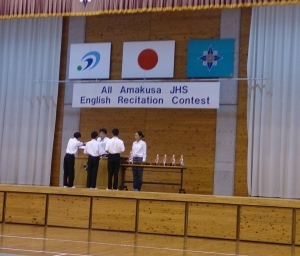 Last year we took five students to the massive(ish) Amakusa regional contest and the results were pretty good!! Our first-year pair and our second year got awards though they didn’t move to the next round, but our third-years got first place and went to the prefectural competition a month later. If this happens you’ll need to keep helping them with their delivery; otherwise, you’re free. The only downside for some of us that had students move on is that for the prefectural our schools didn’t even invite us to attend! We were frustrated by this because we do want to show our support for the kids at any opportunity. Nonetheless though, I was incredibly proud of them. All of the ALT’s wanted the best for their kids but it’s of course a competition. If only all of the kids could move on, then we’d have a real gigantic competition on our hands! And a greater sense of improvement. All of the kids make great improvements over time, so it’s an all-around beneficial exercise for everyone, including the teachers!
 laceywrites