Sotsugyoshiki (卒業式), or Graduation

This is just a quick post I’ve had on the back burner since experiencing it last year. I haven’t got any photos to commemorate the experience, just impressions that I’d like to share.

This year and last year I was required to join the graduation ceremony at my base school, as most ALT’s are. At my school, we all come to the school on Sunday for the ceremony and take Monday off instead.

Only one school year, the junior high school third years, graduate, so this day is really all about them and the homeroom teachers they’ve spent all year with. Because it’s a special event, some teachers dress in full kimono, which comes out looking very stylish and fancy on the female teachers who’ve opted to do so; I haven’t seen any male homeroom teachers fully kimono up yet.

As is often the case in Japan, there are several required practices leading up to the actual event, during which the third years practice walking into the gymnasium in good time as well as standing up and sitting down in perfect time when required. They also have to sing a song of goodbye at the conclusion of the ceremony.

But the third years aren’t the only ones who have to work. The first and second years have to attend as well, all of them sitting in the back, applauding all seven classes as they walk in the gym single-file, continuously clapping. The teachers have to do this too, and I will testify that it can really tire out the hands.

Another aspect of this particular ceremony is that there are a whole lot of speeches being made, which always puts us behind schedule. It would perhaps be better if each speaker kept it brief, but instead each tends to plug on for at least 7-12 minutes. I know that if you try hard on your speech you’d like to read it, but at events like these, most people are tuning out anyway, so I feel that one should keep that in mind when preparing a speech and keep it to around 5 minutes. That way we could eat the bento’s we ordered when they are still warm…

One of my takeaways from this event is that it is relatively cut and dry. One representative goes to the stage and receives their class’s diplomas/certificates, so there isn’t that personal satisfaction in walking across the stage oneself. It’s a rather formulaic ceremony, perhaps for the sake of ceremony. And really what the kids are looking forward to most is likely the last class they have with their homeroom teacher, or tannin (担任). There they share some last moments and give their teachers flowers, thanking them for the entire year. As ALT’s we get a little bit of this on the last class day, depending on the teacher(s) we work with. My teacher got the kids all together and took a picture of us in each class, putting it together as a card for me from each. My teacher from last year made the kids each write a little card, then put them together on a large piece of paper and gave them to me at the end of the last class. This personal interaction is more meaningful than the official ceremony for me as an outsider, but I know that the homeroom teachers felt more accomplishment on behalf of the kids. I had one moment of emotional instability for a class that I really enjoyed because they were bright and motivated, even without knowing the answers all the time, but for the most part I was able to watch the ceremony without undue emotional stress.

All in all, it’s a positive aspect of school life that I think a lot of kids need and look forward to in order to be able to leave junior high and make the transition to high school. It’s another aspect of Japanese school life to experience as an ALT, and it gave me a little time to reflect on my own junior high school experience for sure. It’s interesting to think that I didn’t have a JHS graduation, if I remember correctly. The big graduation hurrahs in the US are high school and university, which worked for me! I’m certainly more than satisfied with my experience of them both, as well as these Japanese ceremonies as a teacher.

Inekari (いねかり): the Rice Harvest

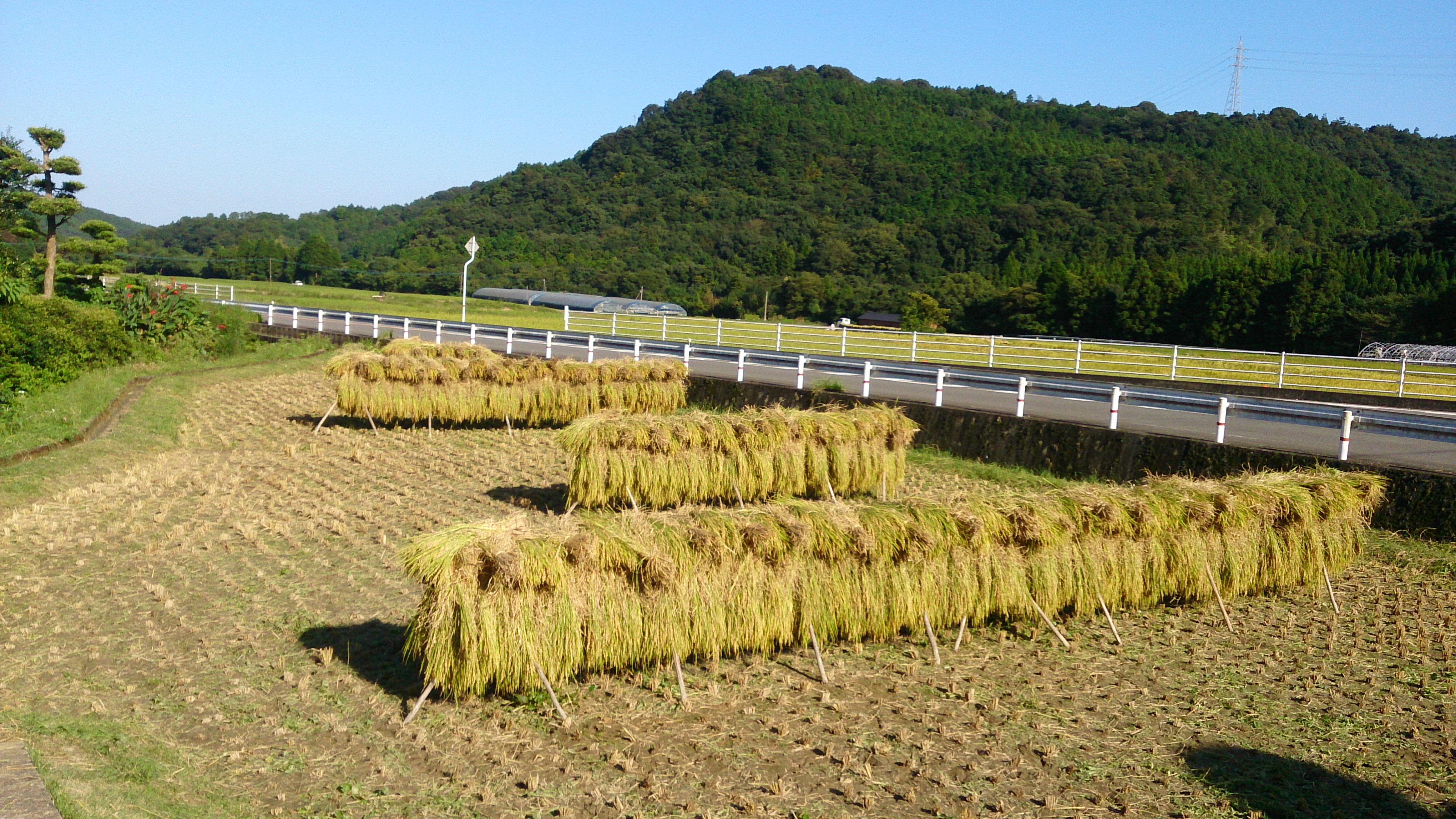
DSC_0150One of the benefits of receiving an inaka placement on the JET program is you might be able to experience traditional Japanese events that you may not be able to in urban placements. I’ve experienced this for myself on multiple occasions at the smaller elementary school I visit roughly once per week.

This particular school, though small, has been kind enough to invite me most often to annual or special school events, one of which is the yearly rice harvest, or inekari (稲刈り). The rice harvest usually occurs in late September to early October. This is an event where we all set out into the small field located close to our school, wearing long sleeves and pants despite the hot weather. This precaution is necessary to protect from the itch of the bugs and or grasses that could possibly effect our experience. A sunhat or large-brimmed hat of some kind is also required, to protect harvesters from resilient late summer, early fall rays. Luckily, both last year and this one, a teacher has been kind enough to lend me their sickle, although most-all students have their own and bring that along. Long rubber boots are also preferred wear, as it can be pretty muddy in the fields.

DSC_0147
The drying stand and cropped roots.

The task is quite enjoyable really, one of those chores that can actually be quite relaxing if you let it. Several people actually harvest the lengthy rice crops with their sickle and lay them in a huge pile. Then others gather the lengthy strands into bunches, tying them together with fresh long straw. After these steps are complete, a couple of people (for us, the field owners, who are pros by this point) set up drying stands that look somewhat like teepee framework, and we all hang the rice on these.

My first year I wasn’t prepared for the occasion, but still insisted on participating in my street clothes. It was fun, though a little itchy. But this year I was prepared! Delayed two weeks in a row because of rain, I had ample time to prepare most of my wear. The first year I mostly stuck to bunching, but this year I harvested and bunched equally quite a bit. While carrying out these duties, I also noticed several little frogs (and spiders) had made the rice field their home in the interim. Our harvesting activities definitely awoke a mass exodus in the frogs, which was quite cute though probably alarming for the creatures due to the fact that a few young boys became very interested in their escape…

All in all inekari is a positive experience! If you get the chance, I’d highly encourage taking part in it at your school(s). Even if someone invites you out to their own home fields it would be a valuable experience.

2014-10-07 15.25.19

Settle Down and Say Hello

Hello everyone!

Apologies for my long hiatus. It’s been an interesting summer indeed. A lot has happened and now I’m back, here to write and post more blogs than ever before!

So for the latter half of July I visited the States, heading back home for a bit of cultural reprieve. While I was gone, Amakusa welcomed 5 new JET’s to the area, and once I was back in-country we welcomed 6 more! So we encountered a huge turnover this year, which is both exciting and nerve-wracking. Two of us helped Group A get settled, while myself and another ALT (a good friend) helped Group B get themselves settled in the area. That in itself was a whirlwind two days. Then I planned a mass dinner with our previous PA (prefectural advisor), current PA, tantousha, and the newbs so we could just bond and have a good time.

After said harried week, I rushed to prep things for Connect in addition to my materials for the next week’s orientation for new ALT’s. The day before which was the best concert of my life (which I’ll comment on in detail later, in a separate post)!!!!

I think this year I’ve been infinitely more busy than when I first arrived. One of my favorite things I did when I got here was work on my introduction English board, which I have pictured below. Whatcha think? I think it’s fun! It really got me through the initial downtime at school.

welcome board

Still have some things to do for Connect and the area, like plan the official welcome party, but other than that it seems it’s calming down a bit on my end. That is, before class begins! ‘Til next time, everyone.

So Long, Farewell. Hello

I’m going to start off this brief update with a bright point: the welcome wagon is rolling out guys! We’ve got a freshly accepted early departure ALT headed for Kamiamakusa, to arrive in April. Though I can’t speak for everyone, I know I’m pretty excited to meet the newest member of our local family. Here’s to new awesome developments! *air toast* I’ll be waiting for the rest of you all too, when July rolls around!

On quite another note however, the departure van is, well departing for us all in a different way. That’s right — early next week the much anticipated teacher exchange takes place. We’re losing some great teachers and, though I’m sure they don’t know it, some warm ALT support at our school. Some teachers who aren’t even involved with us two ALTs talk to us daily as we sit near them, and in doing so, help us to not feel like completely displaced aliens. It’s great. I want to do something nice for them, so I’m going to whip up some gifts by Friday, their last day and the 送別会 (soubetsukai or send-off party).

And though it is a time for endings (though not many of them are going very far!), it also is the beginning for many other things. New students for one. Or not so new students, for those we’ve taught in elementary school. And the new teachers who will take the places of our much beloved departees. Today they announced the incoming teachers and although I only knew one by name (English of course), I’ve got some optimistic hopes. One of my teachers who’s a younger guy joked that there wouldn’t be any ikemen (super fine guys) once he left! I’ll definitely miss his humor. We definitely shared a certain fondness for laughing. But I do hope he’s incorrect! Hahaha. Anyway, that’s all for now folks!

Tokyo Orientation

Three days of Tokyo. You would think it would be amusing but under the fear and unspoken threat of immediate job lossage if you don’t attend the seminars, I know I was not the only one who did not wander about the town as much as I would have liked. (It may also have a lot to do with the fact that I was adjusting to the time difference upon arrival.) These first few days are considered a part of your job, so it is probably best if you can try to treat it as such. Besides, you’ll have plenty of opportunity to plan your own leisure Tokyo trip when you want later. I plan to go back ASAP!

For my free time, I went for tsukemen the first night and hit an izakaya for drinking with a few other newcomers who were from my home state who I wouldn’t see for a while after orientation. There is no shortage of these types of places in the area so I suggest just hitting the pavement and experiencing the city as much as you can. The next night I met up with a Japanese friend I have in the Shinjuku area. She took me to a government building nearby that gives a really good view of surrounding Tokyo scenery and landscape. It was pretty impressive. Then we ate and had a general good time catching up. We wandered around a mall a bit, then I insisted on purikura and hitting a bookstore and we wrapped it up because I had an early morning in store.

When you get to the hotel -hopefully it will still be Keio Plaza Hotel, which is super nice and sparkles- you’ll likely have completely accessible wi-fi, so wait to break out your computers then; don’t run up a foreign cell phone bill unnecessarily. Figuring out ATMs was interesting as well. Just an FYI, you can definitely get money out of a 711 ATM. I was denied at a Japan Post (JP) ATM, which may have been because I use a regional bank but it could also just be their general practice. Another thing is, that for those who brought money in cash and wish to exchange, you can hit the Money Exchange Desk, right next to reception in Keio Plaza. Just a few cool tips.

For those of you accepted and coming in this year though, it may be a little less of a reception than you had hoped. If the Consulates are still telling you that you will have a large welcome committee at the airport, this may no longer be true; CLAIR has eliminated the (unto now) yearly tradition of finding and bringing in Tokyo Orientation Assistants (TOAs). This will unfortunately mean an increase in, for lack of a more polite way to say it, boring and less practical advice presentations when you arrive. Unless they illuminate us on the details of who will be giving the presentations later, it may just be straight CLAIR presentations for two and a half days. Now I enjoy a good talk about rules and how systems work and maybe an outstanding keynote speech now and then, but after a long plane ride it is wearisome and many of you will likely fall asleep in your chairs because you literally sit and listen to someone speak the whole time. If that is the case, don’t feel bad, you are not the only one.

On a broader note, CLAIR has made a lot of changes lately that lead me to believe changes are coming for the program in general (for better or worse) but who knows? It seems that major changes are only implemented every ten years to the education curriculum and such, no matter when originally assessed and approved, but this could also vary by region. Just consider these the random ramblings of a second year.

For those of you coming in, you most likely won’t miss the old things because you didn’t know that they were in place, but some of us are a bit sad to see them go. I know I was looking forward to applying to go help new JETs get their bearings after the long trip.The good thing is that maybe there is still a chance to do so on a local level, so I hope to be chosen by the BoE for that. Regardless, I guess I’ll just have more occasion to use up my vacation time. Which is a very good thing. :)