So, about the middle of last month came time for recontracting. At that time I was thankfully given the papers which extended me the offer of staying for another year, which I am really excited about, so I signed the recontracting paper immediately and returned it to my Board of Education.
Although I’m very excited about all that may come to pass in the next year, I am sad to see some people go. This year, out of the 17 JETs placed in the greater Amakusa area, 11 will be replaced, which means only 6 of the current ALTs in the area are staying! But don’t misinterpret the situation. All is good here in Amakusa, but many situations have led to older JETs moving on to the next tasks in their life. Amakusa is very unique; because we are somewhat displaced from mainland JETs and/or limited by access, we enjoy a close-knit community here. So a lot will change come July/August, but I am really interested to know, meet, and subsequently welcome those who will be joining us this year.
About this time last year I was preparing for my interview, which was somewhat stressful but just remember it involves a certain degree of common sense. I rehearsed very much only to be assigned a comparatively laid-back interview committee (for which I am incredibly grateful). We shared some laughs, addressed the questions, and though I couldn’t be sure I left feeling great, and definitely relieved. That being said, be diligent as well; I heard of other serious interview committees who questioned very pointedly on points of reuniting with Japanese girlfriends and such. (For those of you wondering, I interviewed in Houston.) Best advice: don’t panic or stress to much, and be prepared for either situation. Also – a suit! Absolutely necessary. I was very surprised to see someone turn up without one on my interview day. Everyone will be wearing one so just grin and bear it (the expense and discomfort).
Regardless, come May or June, if you find yourself accepted and your placement to be Amakusa, I will be looking for you! Even if you’re not the incoming JET who will be placed at my school (unique situation – two ALTs in one school), I look forward to setting your mind at ease on some points. I will be prowling the JET forums as well. Though they deleted the entire Aspiring JETs section, the Kumamoto prefecture thread still exists, so I will mainly be looking there.
That’s all for now folks!



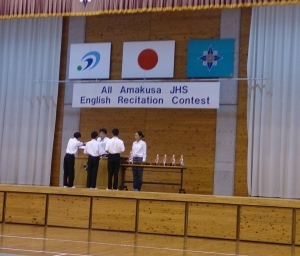 Last year we took five students to the massive(ish) Amakusa regional contest and the results were pretty good!! Our first-year pair and our second year got awards though they didn’t move to the next round, but our third-years got first place and went to the prefectural competition a month later. If this happens you’ll need to keep helping them with their delivery; otherwise, you’re free. The only downside for some of us that had students move on is that for the prefectural our schools didn’t even invite us to attend! We were frustrated by this because we do want to show our support for the kids at any opportunity. Nonetheless though, I was incredibly proud of them. All of the ALT’s wanted the best for their kids but it’s of course a competition. If only all of the kids could move on, then we’d have a real gigantic competition on our hands! And a greater sense of improvement. All of the kids make great improvements over time, so it’s an all-around beneficial exercise for everyone, including the teachers!



 laceywrites