This is just a quick post I’ve had on the back burner since experiencing it last year. I haven’t got any photos to commemorate the experience, just impressions that I’d like to share.
This year and last year I was required to join the graduation ceremony at my base school, as most ALT’s are. At my school, we all come to the school on Sunday for the ceremony and take Monday off instead.
Only one school year, the junior high school third years, graduate, so this day is really all about them and the homeroom teachers they’ve spent all year with. Because it’s a special event, some teachers dress in full kimono, which comes out looking very stylish and fancy on the female teachers who’ve opted to do so; I haven’t seen any male homeroom teachers fully kimono up yet.
As is often the case in Japan, there are several required practices leading up to the actual event, during which the third years practice walking into the gymnasium in good time as well as standing up and sitting down in perfect time when required. They also have to sing a song of goodbye at the conclusion of the ceremony.
But the third years aren’t the only ones who have to work. The first and second years have to attend as well, all of them sitting in the back, applauding all seven classes as they walk in the gym single-file, continuously clapping. The teachers have to do this too, and I will testify that it can really tire out the hands.
Another aspect of this particular ceremony is that there are a whole lot of speeches being made, which always puts us behind schedule. It would perhaps be better if each speaker kept it brief, but instead each tends to plug on for at least 7-12 minutes. I know that if you try hard on your speech you’d like to read it, but at events like these, most people are tuning out anyway, so I feel that one should keep that in mind when preparing a speech and keep it to around 5 minutes. That way we could eat the bento’s we ordered when they are still warm…
One of my takeaways from this event is that it is relatively cut and dry. One representative goes to the stage and receives their class’s diplomas/certificates, so there isn’t that personal satisfaction in walking across the stage oneself. It’s a rather formulaic ceremony, perhaps for the sake of ceremony. And really what the kids are looking forward to most is likely the last class they have with their homeroom teacher, or tannin (担任). There they share some last moments and give their teachers flowers, thanking them for the entire year. As ALT’s we get a little bit of this on the last class day, depending on the teacher(s) we work with. My teacher got the kids all together and took a picture of us in each class, putting it together as a card for me from each. My teacher from last year made the kids each write a little card, then put them together on a large piece of paper and gave them to me at the end of the last class. This personal interaction is more meaningful than the official ceremony for me as an outsider, but I know that the homeroom teachers felt more accomplishment on behalf of the kids. I had one moment of emotional instability for a class that I really enjoyed because they were bright and motivated, even without knowing the answers all the time, but for the most part I was able to watch the ceremony without undue emotional stress.
All in all, it’s a positive aspect of school life that I think a lot of kids need and look forward to in order to be able to leave junior high and make the transition to high school. It’s another aspect of Japanese school life to experience as an ALT, and it gave me a little time to reflect on my own junior high school experience for sure. It’s interesting to think that I didn’t have a JHS graduation, if I remember correctly. The big graduation hurrahs in the US are high school and university, which worked for me! I’m certainly more than satisfied with my experience of them both, as well as these Japanese ceremonies as a teacher.

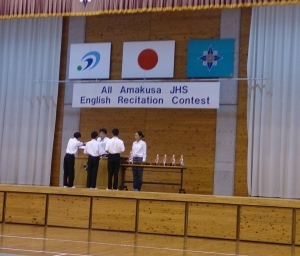 Last year we took five students to the massive(ish) Amakusa regional contest and the results were pretty good!! Our first-year pair and our second year got awards though they didn’t move to the next round, but our third-years got first place and went to the prefectural competition a month later. If this happens you’ll need to keep helping them with their delivery; otherwise, you’re free. The only downside for some of us that had students move on is that for the prefectural our schools didn’t even invite us to attend! We were frustrated by this because we do want to show our support for the kids at any opportunity. Nonetheless though, I was incredibly proud of them. All of the ALT’s wanted the best for their kids but it’s of course a competition. If only all of the kids could move on, then we’d have a real gigantic competition on our hands! And a greater sense of improvement. All of the kids make great improvements over time, so it’s an all-around beneficial exercise for everyone, including the teachers!
 laceywrites