Yatsushiro Fireworks Festival 八代花火大会

Throughout Japan, there are several national festivals celebrating fireworks, where many well-known fireworks-makers get together and show off their products. One of these occurs relatively close to my placement in a town called Yatsushiro. This is one of the more crowded events I’ve been to in Japan, because everyone goes crazy for a fireworks show here, not to say I blame them. This type of show is usually worth a visit due to the breadth and depth of the show, showcasing works for a good hour or two.

I decided to attend the event with a friend, and we rode into town on the train a good hour before the show started. As some of my friends realized after the fact, traffic is horrible in the area surrounding the event space, which spans both sides of a river and most roads in the Japanese countryside are one lane, so it’s advisable to use public transport at times like these. The show didn’t start until 6 but we headed down at about 4:30, which was a really good call! As I said before, this is a crowded event, and even at 4:30 the trolley to the train station and subsequently the train was filled to the brink with people. Thanks to being an obvious foreigner, I was somewhat spared the people sandwiching due to my natural ‘gaikokujin aura,’ holding the Japanese around me at arm’s length through no effort of my own.

This particular show is held in late summer, so it’s a bit hot if you go, but if you bring a blanket or a chair and a couple of buds to man the space while you each track down snacks and drinks, it’s a great time. A lot of fireworks companies apparently come down to the area to showcase some of their better fireworks, with small breaks in between each company’s display. It was really worth seeing, so if you notice there’s one around you, definitely go at least once!

Nagasaki Adventure [Day 2]

Day two began with a fair amount of shrine and temple hopping, which I remember being very excited about. Since we started our journey on the north side of the city and started working our way down, we wanted to go ahead and hit the next thing, which was Temple Street, aka Tera-machi-dori. I’m quite enthusiastic about temples and shrines so I really enjoyed this walk even with it being a bit hot. By the end of it my accomplices were about “temple-d out,” and I was still ready to go! But it’s likely a good thing we cut it short with all the uphill slopes!

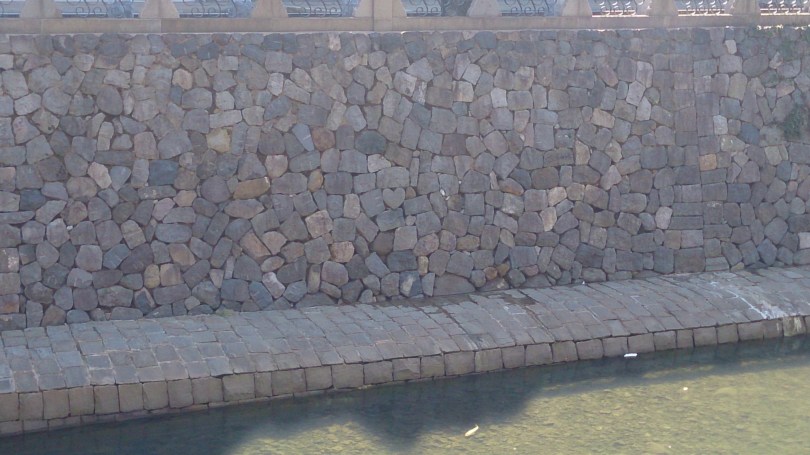
2013-10-13 12.28.27After completing our fair circuit of temples and shrines throughout the area, we started our route toward Chinatown by stopping to take in the Spectacles Bridge. While we were meandering through the area, an elderly man gifted his map to me, and directed my attention to a particular area of the stones in which a certain shape could be found. Can you find it in the picture at the beginning of this entry? I’m thinking so. :)

2013-10-13 13.02.25Afterward we made our way to Chinatown on the tram, which is a flat rate and something that many cities in Japan enjoy. Our main reason for stopping here was to have champon, a mixed seafood noodle dish, borrowed from Chinese cuisine. We popped into a fairly crowded and popular restaurant with good timing and grabbed a table, settling down to stuff ourselves with Chinese food. We circled the rest of Chinatown and found out – much to our disbelief – that Chinatown consisted of exactly one street! We were pretty surprised by this, given all the talk about it being Japan’s first Chinatown; we just had expected it to be a little more built out. But nonetheless, we made the circuit of shops and checked it off our to-do list!

Our last stop of the day was stopped Glover Garden, and the more general area of the Dutch Hollander slope leading up to it. We only stopped briefly at the garden because we were tired from all the walking, but it has a great view out onto the city of Nagasaki itself, so it’s no wonder the Glovers seized up that land immediately and built upon it.  The slope is a very cool area with many food stands and souvenir shops, but also some very cool jewelry stores further up the slope for those who are interested. I also bought a whole lot of omiyage in the form of castella cake from the souvenir shops. They have all kinds so I went kind of wild and picked a few to bring back to my schools.

We got back into town and decided that we were fairly ravenous, so we lighted upon this Italian place in the mall. The three of us had no idea, but the weekend we were there it happened to be romance/couples weekend or some such thing, which explained why we were unable to get a hotel, but the unforeseen plus was that we had a perfect view of a major spectacle of the event – fireworks! It was unexpected but great as we leisurely ate pizza and pasta, and drank wine. It was a pretty fun time.

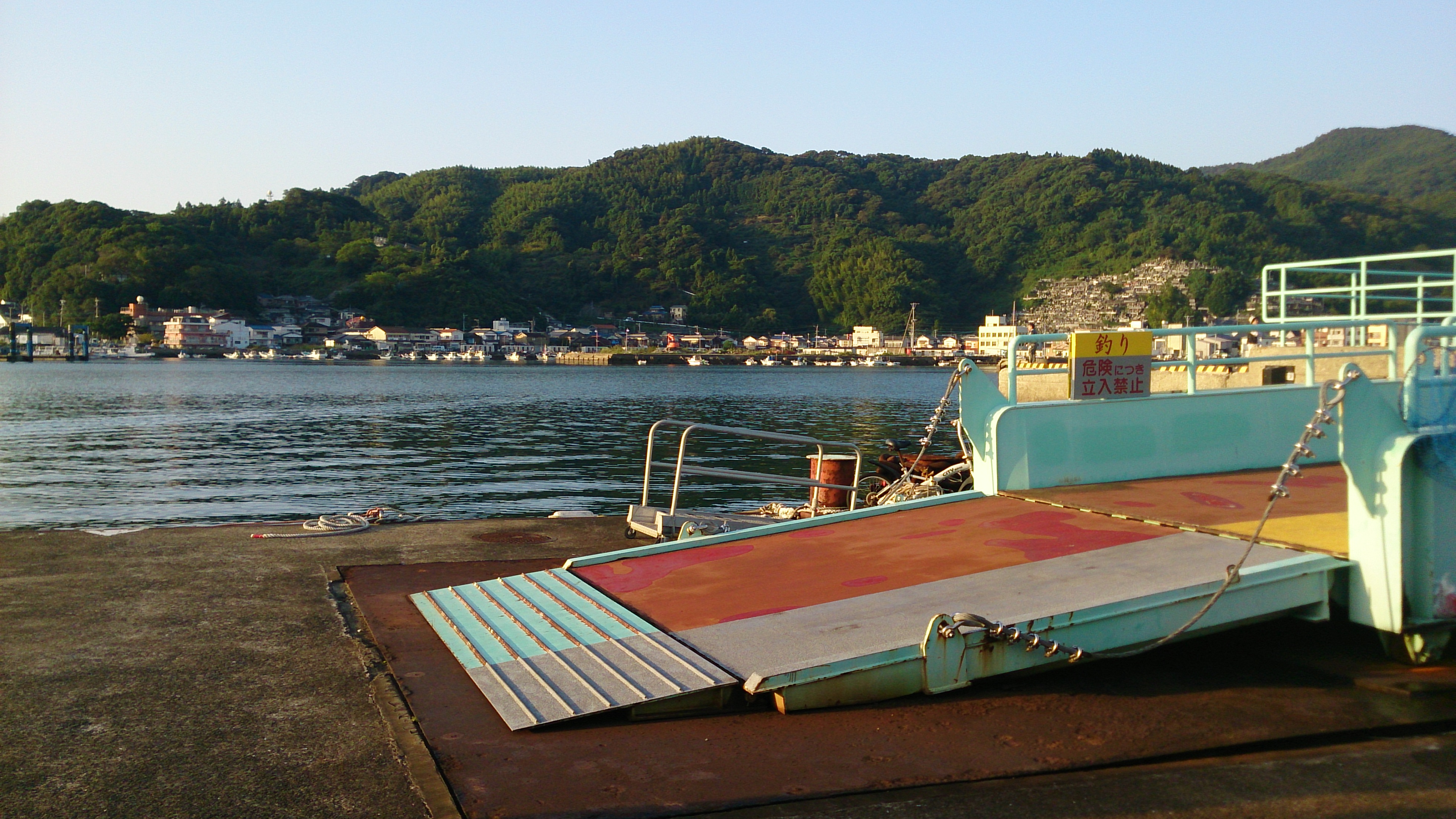
Getting on the ferry home...
Catching the ferry home…

Then we Cybac’ed (one of the better, cleaner Cybac’s I’ve been in on both nights) it again and woke up at the crack of dawn the next day to hit the bus and catch the earliest ferry home. Once there we drove back into our placement city. Though it was a bit of a tiring excursion it was very worth it. And there’s still more stuff I’d like to do in Nagasaki!! It’s a great city.

Nagasaki Adventure [Day 1]

During my first year here, in October 2013, a couple of friends and I seized the opportunity to visit Nagasaki over the course of a 3-day weekend. We took the passenger-only ferry from Reihoku over, and initially sat inside. It was an odd sensation; bobbing up and down amidst waves that you couldn’t see. Then we hopped on the bus and rode into town to start our adventure!

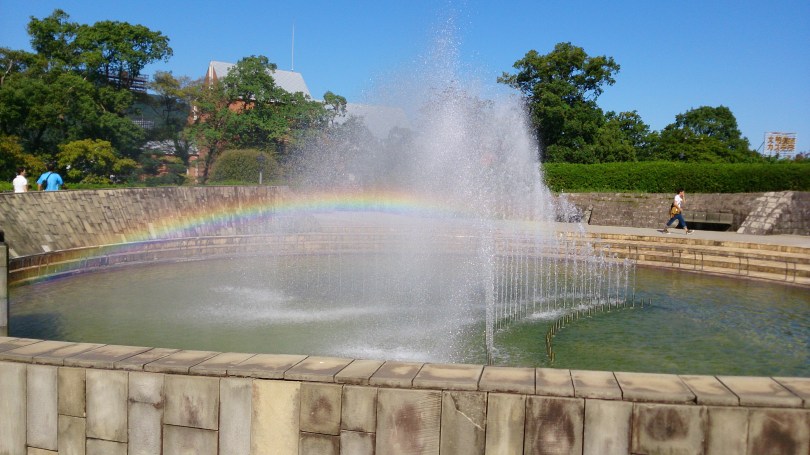
First we stopped at the Peace Park, taking in all the sculptures and artwork dedicated to the area throughout the years. Then we stopped by the Atomic Bomb Museum, walking and stopping through at various smaller parks and outdoor sights along the way. For example – shrines – of which there is no shortage in Nagasaki. There was an incredibly large set of old trees framing the front of a shrine I don’t remember the name of, so we stopped in briefly, then continued on our way to food at Amu Plaza, choosing to dine on the Indian food that’s all-too-rare in Amakusa.

After satiating our appetite and perhaps doing a little shopping, we headed to Mt. Inasa Ropeway, the bottom of which is located inside of Fuchi Shrine. We were good in our timing insofar as we went around 5 PM and ended up staying until sunset/dusk. Apparently Nagasaki ranks #5 on some lists of the best night views in Japan. It was really beautiful and totally worth stopping by. But if you decide to go get there early! There’s so many cameramen who set up to capture the sunset that it’s a little ridiculous. Inside there also happened to be a cool concert going on showcasing some various artists, mostly incorporating some traditional element into their performances.

2013-10-12 20.25.40
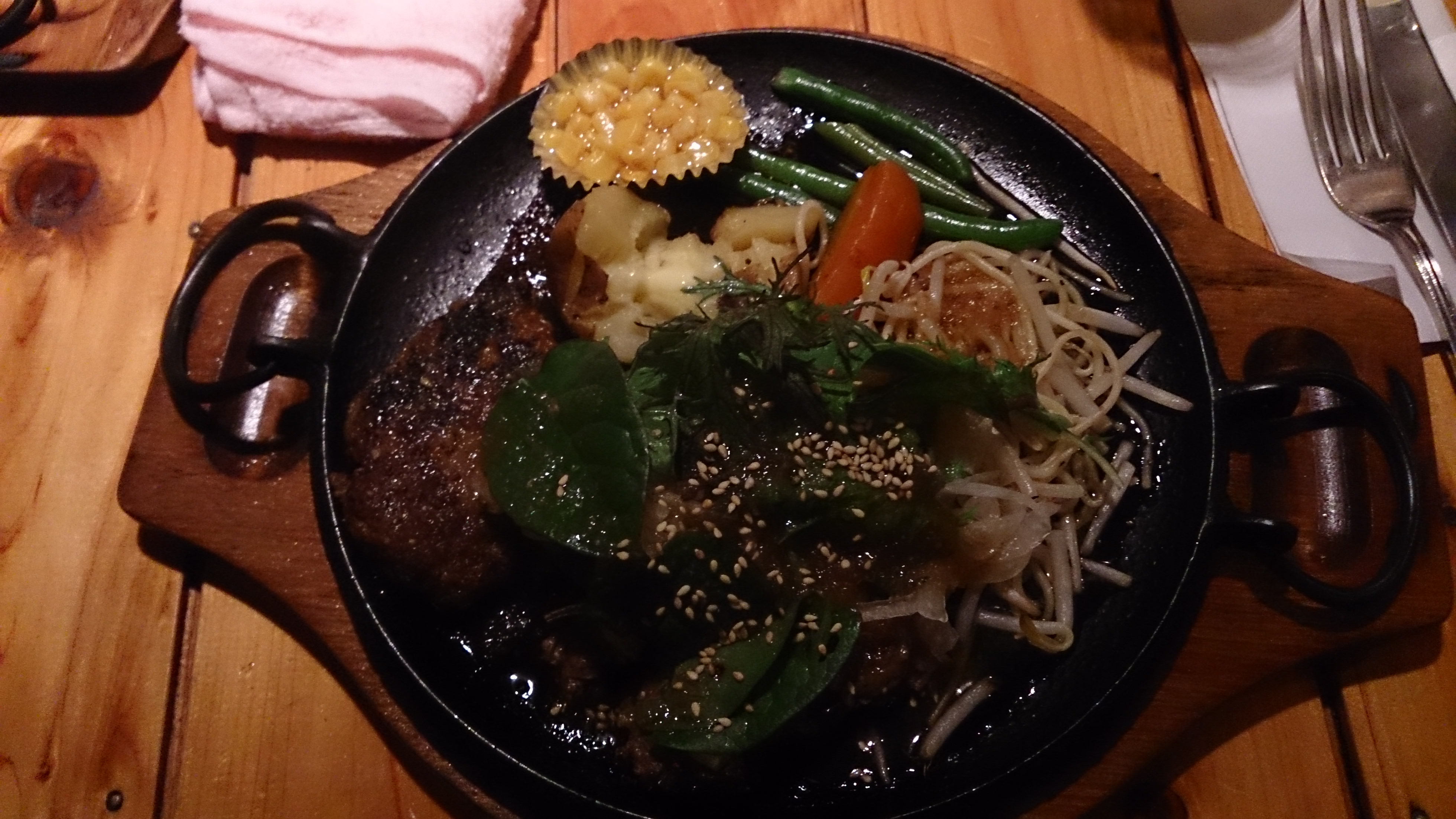
My tasty steak dish~

After enjoying all we could for the first day, we set out to find a restaurant called Bronco, located in Nagasaki’s street arcade. I had read online that it was a Mexican and steak restaurant, thus my urge to go, but it turns out it is an exclusively steak restaurant. Though at first I was a little disappointed, it was a very good meal, and it proved worth the visit regardless of my initial impression from online. The shop is quite small and narrow, so it’s a bit awkward, and the food is tasty once you get your hands on it. It was a busy night there, it seemed.

A random koban, or police box, that we stumbled upon during our wanderings

A first for me with this trip was the unique experience of what I like to call Cybac’in’ it. Cybac is a particular net cafe franchise, where you can rent a space for 12 hours for a very cheap price. If you’re picky you can even purchase a shower or anything else on the menu you might need. The idea is that you browse the internet or use the computer during this space of time, but it the cheapest, though not necessarily most comfortable, alternative to paying for a hotel room! There’s no reservations though, so you have to be willing to live in the moment and be flexible regarding which space you stay in (a 1 person, 2 person, or family room).

That’s the end of Day 1! I have a lot in the backlog for now, so keep an eye out for Day 2, coming soon.

Inekari (いねかり): the Rice Harvest

DSC_0150One of the benefits of receiving an inaka placement on the JET program is you might be able to experience traditional Japanese events that you may not be able to in urban placements. I’ve experienced this for myself on multiple occasions at the smaller elementary school I visit roughly once per week.

This particular school, though small, has been kind enough to invite me most often to annual or special school events, one of which is the yearly rice harvest, or inekari (稲刈り). The rice harvest usually occurs in late September to early October. This is an event where we all set out into the small field located close to our school, wearing long sleeves and pants despite the hot weather. This precaution is necessary to protect from the itch of the bugs and or grasses that could possibly effect our experience. A sunhat or large-brimmed hat of some kind is also required, to protect harvesters from resilient late summer, early fall rays. Luckily, both last year and this one, a teacher has been kind enough to lend me their sickle, although most-all students have their own and bring that along. Long rubber boots are also preferred wear, as it can be pretty muddy in the fields.

DSC_0147
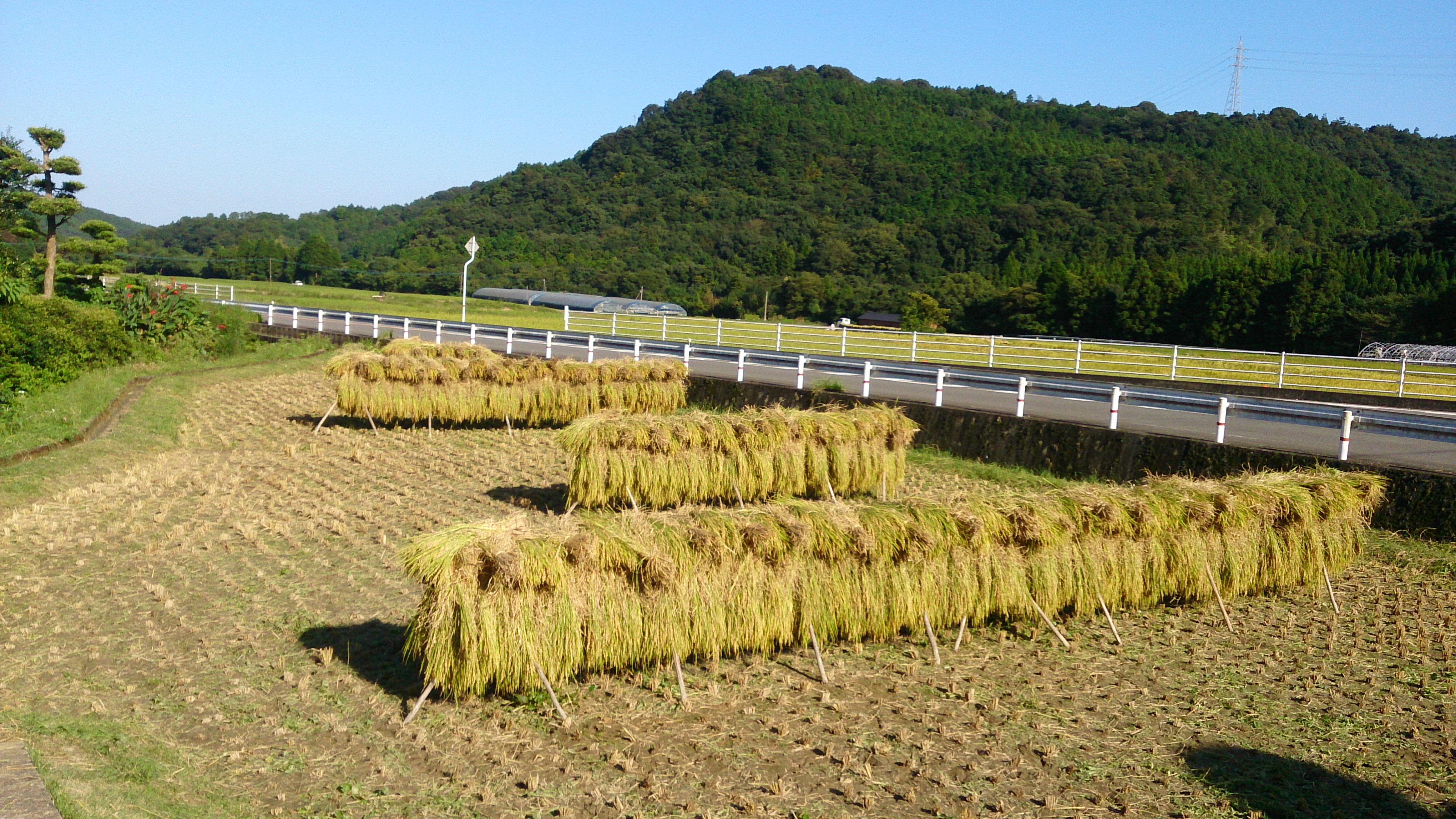
The drying stand and cropped roots.

The task is quite enjoyable really, one of those chores that can actually be quite relaxing if you let it. Several people actually harvest the lengthy rice crops with their sickle and lay them in a huge pile. Then others gather the lengthy strands into bunches, tying them together with fresh long straw. After these steps are complete, a couple of people (for us, the field owners, who are pros by this point) set up drying stands that look somewhat like teepee framework, and we all hang the rice on these.

My first year I wasn’t prepared for the occasion, but still insisted on participating in my street clothes. It was fun, though a little itchy. But this year I was prepared! Delayed two weeks in a row because of rain, I had ample time to prepare most of my wear. The first year I mostly stuck to bunching, but this year I harvested and bunched equally quite a bit. While carrying out these duties, I also noticed several little frogs (and spiders) had made the rice field their home in the interim. Our harvesting activities definitely awoke a mass exodus in the frogs, which was quite cute though probably alarming for the creatures due to the fact that a few young boys became very interested in their escape…

All in all inekari is a positive experience! If you get the chance, I’d highly encourage taking part in it at your school(s). Even if someone invites you out to their own home fields it would be a valuable experience.

2014-10-07 15.25.19